In ancient Greek education, the practice of “writing in role,” such as composing a letter or speech as if you were a historical or fictional figure like Socrates, was known as ethopoeia (ἠθοποιία). This exercise involved crafting a speech or text in the character, tone, and perspective of a specific person, often to demonstrate understanding of their personality, beliefs, or style. It was commonly used to develop skills in persuasion, empathy, and stylistic variety.
Activity: pretend you are a famous person or character and write a letter to a friend
The new school year is getting near. What are your new school year resolutions? Do you want to do better in a subject this year? Do you want to make a new close friend? Write down your top five goals for this year. What is the difference between a hope and a goal?
Have you ever played the telephone game? One person starts with a sentence that they say to second person, who then says it to a third person, and so on through the group trying to keep the sentence the same. What we find is that the sentence you start with is often very unlike the sentence you end with.
Imagine you played the telephone game. The sentence you started with was:
WE BOUGHT EGGS AT THE MARKET
And by the time you got to the 10th person telling it the sentence became
THE CLOWN IN THE WHITE MAKEUP AND RED NOSE ROSE FROM THE DEAD
Wow, that’s quite the change. Make a story line showing the steps in which the first sentence slowly changed into the last sentence.
Why might this be a problem in doing ancient history before they had cameras and most people couldn’t read or write?
A family crest or coat of arms show what a family wanted people to think about them. What do you think the lions in the coat of arms above mean? Design a coat of arms showing the important things in your life.
Oklahoma’s Department of Education collaborates with PragerU to create an assessment for incoming teachers, ensuring commitment to ‘America First’ education.
“You Can Do Magic” is a song by singer-songwriter Russ Ballard that was recorded as a 1982 single by folk rock duo America from their album View from the Ground.
Can you write a similar poem or song about magicless magic?
Mr. Bob was exhausted. Last night’s hockey game on tv went into double overtime, so he didn’t get to sleep until 1:30 am. Luckily, as teachers know, in this situation it’s time to kill time by showing the class a video!
Billy had been thinking that maybe Mr. Bob couldn’t do magic at all. Looking down at a fuzzy caterpillar munching on a leaf, Billy had an idea.
Later in front of the class, Billy challenged: “If you can really do magic, Mr. Bob, change this caterpillar into a butterfly.”
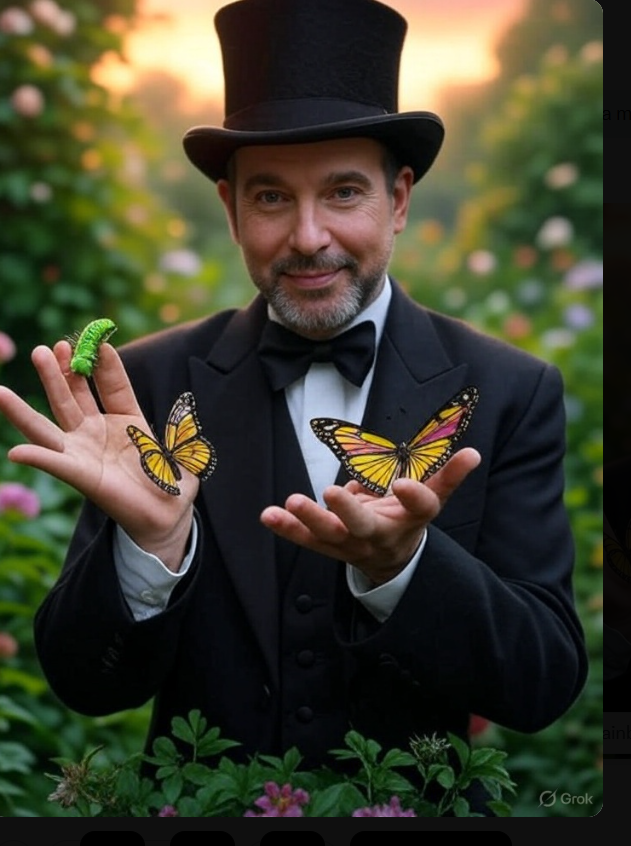
“Sure,” replied Mr. Bob, not fazed by the challenge, and proclaimed “ALAKAZOO, caterpillar to butterfly!” There was a puff of smoke and a flash of lightning, and when the smoke cleared the caterpillar remained as it was before.
“I knew it,” Billy exclaimed, “You didn’t cast a spell at all!”
“Sure, I did,” replied Mr. Bob. “Take the caterpillar home and wait for 2 weeks. This spell takes a little longer, but you’ll have your butterfly.”
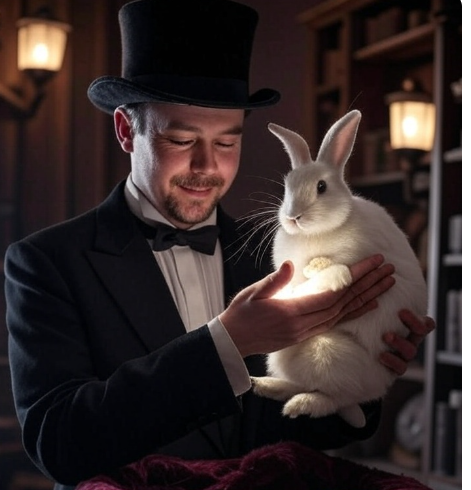
After a long day of teaching the kids how magic tricks work, Mr. Bob picked up his rabbit Fred and began to think out loud.
“You know,” Bob said, “It’s amazing to think how much thinking we do in a day talking to ourselves, and yet not out loud!”
Fred nodded.
“Imagine a world where everyone thought out loud and people thought whatever they wanted and never worried about what others thought!” Mr. Bob exclaimed.
Fred pooped.
“Anyway,” Bob remarked, “it was a good day of explaining fake magic so let’s cast a real magic spell and call it a day. ALAKAZOO! FRED OLDER!”
All of the sudden, there was a flash of lightning and a cloud of smoke, and Fred was slightly older when the smoke cleared than he was before the flash of lightning.
Adam had stayed in his seat after class looking depressingly out the window.
“Alakazoo” shouted Mr. Bob, as in a puff of smoke he transformed a closed can of Sprite into an open one and handed it to Adam.
“Thanks,” Adam said. “Just having a bad day today.”
“Nonsense,” Mr. Bob claimed. “Every glass is half full and every cloud has a silver lining. Turn that mess into a message; that test into a testimony; that trial into a triumph; being a victim into a victory. What I’m saying sounds poetic so it must be true!”
“Life doesn’t seem poetic,” Adam said.
“You know what the difference between a poem and a story is?” Mr. Bob asked. “With a story you try to skip over things to understand the general plot: the problem and solution. A poem is the opposite. Every word is looked at very carefully and returned to many times to try and figure out what it’s “doing” in the poem. Stories are for understanding meaning. Poems are for exploring what words are doing, how they are working in the poem. Life can be hard if the big picture looks gloomy, but poets know any situation can keep revealing new and wonderful things the more we live every little moment and appreciate it.”
“My mom is cooking corned beef and cabbage tonight,” Adam complained.
The teacher shrugged. “Sometimes we can’t think our ways out of things,” Mr. Bob admitted.