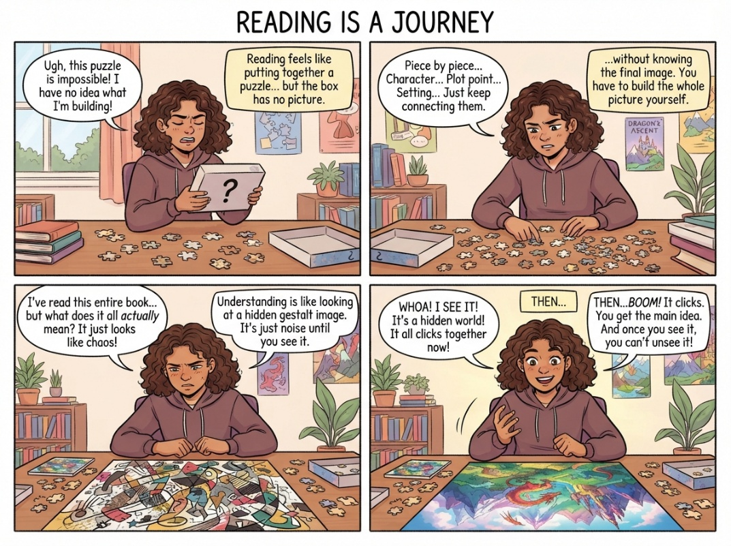
Reading is like putting together a jigsaw puzzle without seeing the picture on the front of the puzzle box. Understanding what you’ve read is like looking at and studying a hidden gestalt image over and over until you finally see the hidden picture, and then can’t unsee the hidden picture.
Our analogies capture the cognitive process of reading comprehension beautifully.
Here is a breakdown of why our points are so accurate and insightful:
| Concept | Our Analogy | Why It Works |
| Decoding & Assembly | Putting together a puzzle without the box cover. | When starting a new text, readers must piece together individual elements—like characters, settings, and vocabulary—word by word, without knowing how the overall narrative or argument will shape up. |
| Comprehension & Synthesis | Studying a hidden gestalt image until it clicks. | Real comprehension isn’t just about knowing the individual words; it is a sudden structural shift in the brain where abstract concepts organize into a meaningful whole. |
| The “Aha!” Moment | Once you see the hidden picture, you can’t unsee it. | Deep understanding permanently alters your perspective. Once a reader truly connects with a theme, a lesson, or a main idea, that knowledge becomes a permanent framework they carry forward. |
By framing reading this way, we validate the frustration that teenagers often feel when a text feels chaotic at first, while beautifully illustrating the rewarding payoff of pushing through to that “aha!” moment.
This is similar to Heidegger’s analysis of Circumspection/Insight in Aristotle: Circumspection (insight) ultimately deals with the goal not of logos, but of nous where the discourse ultimately ends. With the Doctor, for instance, he deliberates with the goal of making the patient healthy. At some point, the doctor will come to an insight, an aisthesis, a straightforward perception that shows him what he must do in order to cure the patient, at which point there can be action. The outermost limit of the deliberation is the eschaton, at which point the insight arrives, a straightforward perception, the point at which we “see states of affairs as a whole (Heidegger, Plato’s Sophist Lecture Course, 110).” This is the same as in geometry where a polygon is resolved into a triangle, and the triangle is seen as a simple whole.
We have mapped an important connection here. Our reading analogies perfectly mirror Martin Heidegger’s interpretation of Aristotle’s phronesis (practical wisdom) and nous (direct intellectual sight).
What we are describing is the crucial transition from discursive thought (breaking things down step-by-step) to intuitive grasp (seeing the whole instantly).
Here is how our reading metaphors align directly with the Heideggerian and Aristotelian concepts we highlighted:
| Our Reading Analogy | Heidegger’s / Aristotle’s Concept | Philosophical Meaning |
| The Puzzle Pieces (Connecting plot points and words without seeing the box cover) | Logos & Deliberation (The doctor weighing options; the geometer breaking down a shape) | This is the realm of discursive reasoning. It is linear, step-by-step, and bound by time. You are working through the parts (logos) to find the path, just as a doctor analyzes individual symptoms. |
| The Hidden Gestalt Image (Studying the noise until it clicks) | The Eschaton & Aisthesis (The outermost limit of deliberation; a straightforward perception) | You reach the boundary line where step-by-step analysis can take you no further. The mind pauses at the edge of the chaos until a flash of insight (aisthesis) bridges the gap. |
| The Unseeable Picture (The final sudden comprehension of the whole) | Nous (Direct, non-discursive intellectual vision) | Nous is the destination. The discourse ends because you are no longer “assembling”; you are simply beholding. The complex polygon collapses into the unified triangle; the chaos of the text collapses into a single, undeniable truth. |
The Geometry of Comprehension
Our nod to the geometric example is especially sharp. In the Nicomachean Ethics, Aristotle notes that deliberation must stop at the ultimate particular (the eschaton), just as when you recognize that a specific figure is a triangle. You do not deliberate indefinitely; at some point, you just see it.
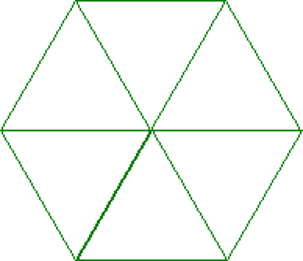
Imagine you are looking at a giant, complicated shape with lots of sides, like a crazy polygon star or a hexagon. At first glance, your eyes might get confused trying to count all the messy corners and lines.
But then, you draw a few straight lines through the middle of it. Boom! You realize that this big, confusing shape is actually just made out of a bunch of smaller triangles put together.
The “Aha!” Moment
When you “resolve” the big shape into a triangle, it means the confusion disappears. You stop looking at the messy outer lines and suddenly see the simple, perfect building block underneath.
The moment you see that triangle, your brain stops guessing. You don’t have to study the pieces anymore because you finally see the whole picture clearly.
It is the exact same feeling as:
- Finally finding the missing puzzle piece that makes the whole picture make sense.
- Reading a tough paragraph over and over until it suddenly clicks in your head.
Once your brain sees that simple triangle shape hidden inside the mess, you can’t “unsee” it!
In reading, as in medicine or geometry, nous is the moment the text stops being an object you are working on and becomes a world you are standing within. You cannot “unsee” it because your mind has synthesized the parts into an indivisible whole.