
(2/2) What is Reading? A Joint Post on Secular Frontier and Secular Web Kids
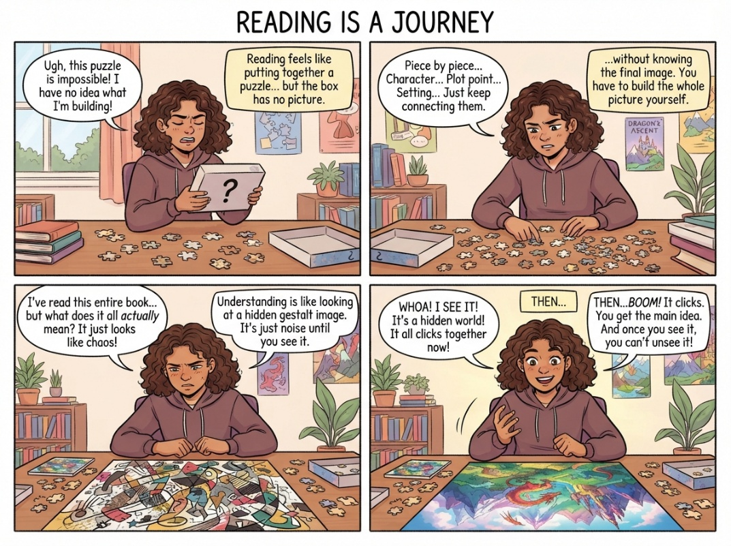
Reading is like putting together a jigsaw puzzle without seeing the picture on the front of the puzzle box. Understanding what you’ve read is like looking at and studying a hidden gestalt image over and over until you finally see the hidden picture, and then can’t unsee the hidden picture.
Our analogies capture the cognitive process of reading comprehension beautifully.
Here is a breakdown of why our points are so accurate and insightful:
| Concept | Our Analogy | Why It Works |
| Decoding & Assembly | Putting together a puzzle without the box cover. | When starting a new text, readers must piece together individual elements—like characters, settings, and vocabulary—word by word, without knowing how the overall narrative or argument will shape up. |
| Comprehension & Synthesis | Studying a hidden gestalt image until it clicks. | Real comprehension isn’t just about knowing the individual words; it is a sudden structural shift in the brain where abstract concepts organize into a meaningful whole. |
| The “Aha!” Moment | Once you see the hidden picture, you can’t unsee it. | Deep understanding permanently alters your perspective. Once a reader truly connects with a theme, a lesson, or a main idea, that knowledge becomes a permanent framework they carry forward. |
By framing reading this way, we validate the frustration that teenagers often feel when a text feels chaotic at first, while beautifully illustrating the rewarding payoff of pushing through to that “aha!” moment.
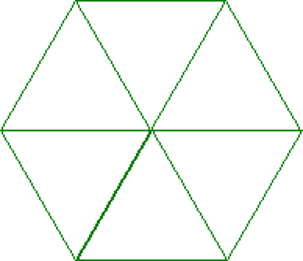
This is similar to Heidegger’s analysis of Circumspection/Insight in Aristotle: Circumspection (insight) ultimately deals with the goal not of logos, but of nous where the discourse ultimately ends. With the Doctor, for instance, he deliberates with the goal of making the patient healthy. At some point, the doctor will come to an insight, an aisthesis, a straightforward perception that shows him what he must do in order to cure the patient, at which point there can be action. The outermost limit of the deliberation is the eschaton, at which point the insight arrives, a straightforward perception, the point at which we “see states of affairs as a whole (Heidegger, Plato’s Sophist Lecture Course, 110).” This is the same as in geometry where a polygon is resolved into a triangle, and the triangle is seen as a simple whole.
We have mapped an important connection here. Our reading analogies perfectly mirror Martin Heidegger’s interpretation of Aristotle’s phronesis (practical wisdom) and nous (direct intellectual sight).
What we are describing is the crucial transition from discursive thought (breaking things down step-by-step) to intuitive grasp (seeing the whole instantly).
Here is how our reading metaphors align directly with the Heideggerian and Aristotelian concepts we highlighted:
| Our Reading Analogy | Heidegger’s / Aristotle’s Concept | Philosophical Meaning |
| The Puzzle Pieces (Connecting plot points and words without seeing the box cover) | Logos & Deliberation (The doctor weighing options; the geometer breaking down a shape) | This is the realm of discursive reasoning. It is linear, step-by-step, and bound by time. You are working through the parts (logos) to find the path, just as a doctor analyzes individual symptoms. |
| The Hidden Gestalt Image (Studying the noise until it clicks) | The Eschaton & Aisthesis (The outermost limit of deliberation; a straightforward perception) | You reach the boundary line where step-by-step analysis can take you no further. The mind pauses at the edge of the chaos until a flash of insight (aisthesis) bridges the gap. |
| The Unseeable Picture (The final sudden comprehension of the whole) | Nous (Direct, non-discursive intellectual vision) | Nous is the destination. The discourse ends because you are no longer “assembling”; you are simply beholding. The complex polygon collapses into the unified triangle; the chaos of the text collapses into a single, undeniable truth. |
The Geometry of Comprehension
Our nod to the geometric example is especially sharp. In the Nicomachean Ethics, Aristotle notes that deliberation must stop at the ultimate particular (the eschaton), just as when you recognize that a specific figure is a triangle. You do not deliberate indefinitely; at some point, you just see it.
Imagine you are looking at a giant, complicated shape with lots of sides, like a crazy polygon star or a hexagon. At first glance, your eyes might get confused trying to count all the messy corners and lines.
But then, you draw a few straight lines through the middle of it. Boom! You realize that this big, confusing shape is actually just made out of a bunch of smaller triangles put together.
The “Aha!” Moment
When you “resolve” the big shape into a triangle, it means the confusion disappears. You stop looking at the messy outer lines and suddenly see the simple, perfect building block underneath.
The moment you see that triangle, your brain stops guessing. You don’t have to study the pieces anymore because you finally see the whole picture clearly.
It is the exact same feeling as:
- Finally finding the missing puzzle piece that makes the whole picture make sense.
- Reading a tough paragraph over and over until it suddenly clicks in your head.
Once your brain sees that simple triangle shape hidden inside the mess, you can’t “unsee” it!
In reading, as in medicine or geometry, nous is the moment the text stops being an object you are working on and becomes a world you are standing within. You cannot “unsee” it because your mind has synthesized the parts into an indivisible whole.
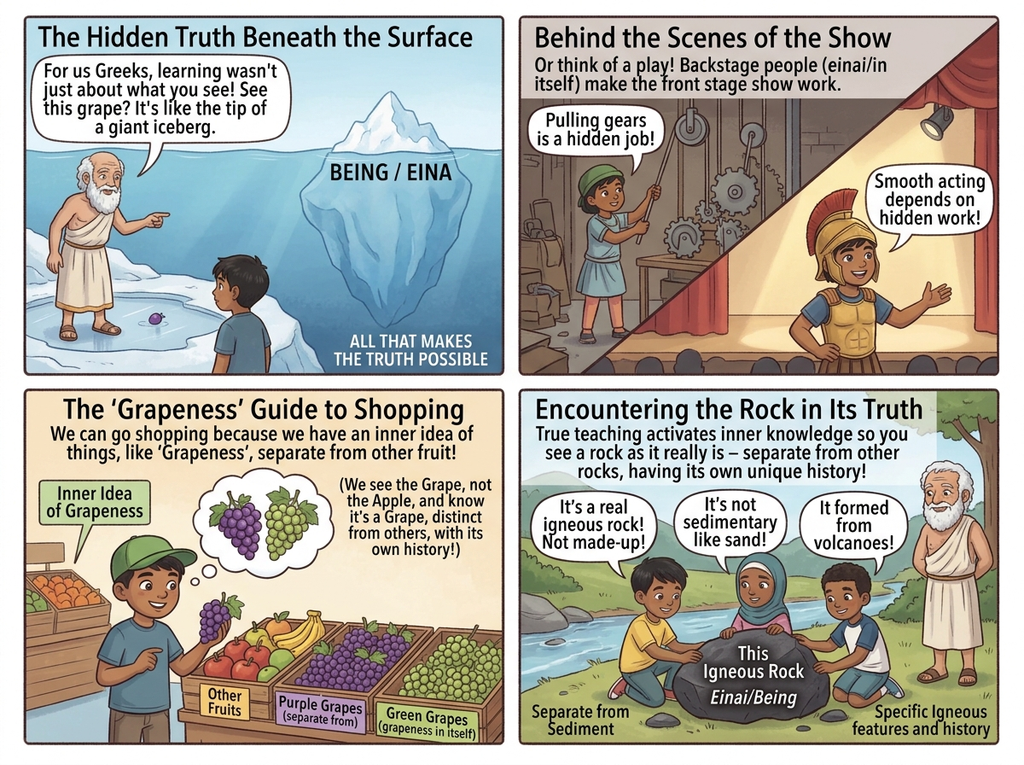
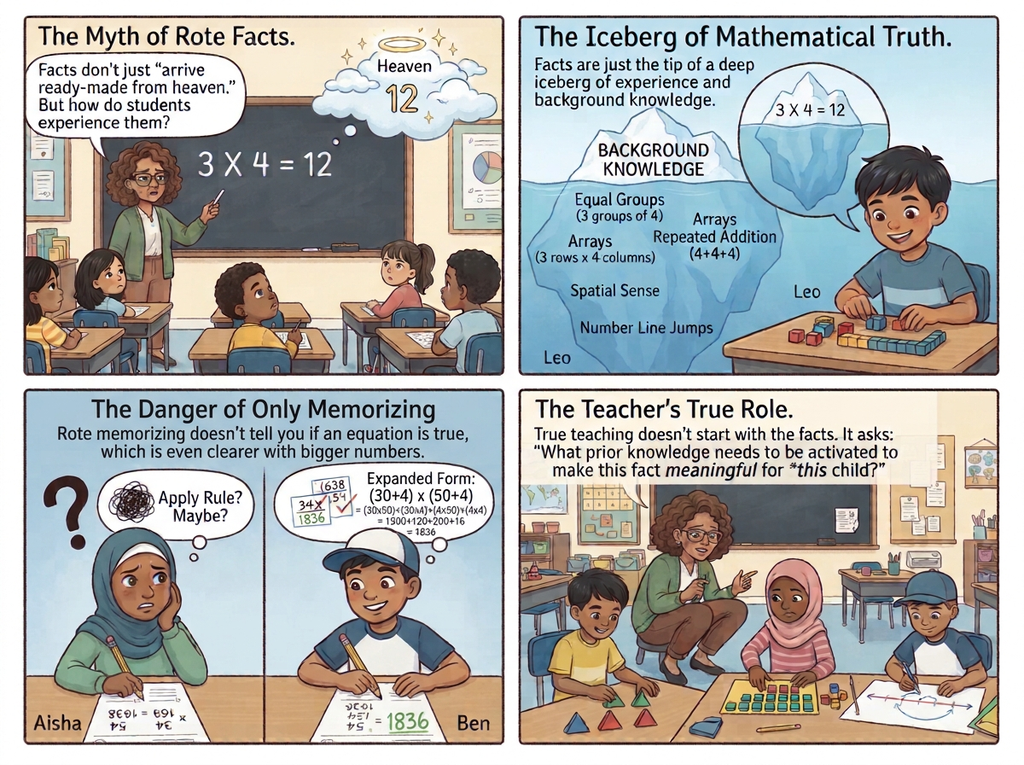
For the Greeks Philosophy was interested in Being, which was the iceberg beneath the surface of the water when all you can see is the tip, or what is going on behind the scenes that makes the theater play on the stage possible and run smoothly. For example, we have grapeness before our mind’s eye that allows us to have a successful trip to the grocery store. In The Sophist, Plato says every thing operates in this way according to einai (Being), choris (separate from), ton alloon (the others), and kath auto (in itself). I encounter the rock, “as something rather than nothing,” “as not me,” “as igneous with igneous features and formation history” “as not a metamorphic rock or sedimentary rock,” etc.
Once upon a time, on the edge of a deep, ancient forest, there ran a roaring, modern highway. Cars and trucks barreled down it day and night, moving fast like lines of data inside a supercomputer.
Right next to this busy road lived two very different creatures: Horace the Hedgehog and Master Jada the Jedi.
📐 Panel 1: The Sharp Shape
One sunny morning, Horace and Master Jada were walking along the path when they stumbled upon a smooth, wooden right-angle triangle lying in the grass.
“Look!” squeaked Horace. He pulled out a small, metal ruler. “I know exactly what this is. It is a three-sided object. Its bottom is exactly four inches, its height is three inches, and its formula is (a^2 + b^2 = c^2). I have memorized the definition. The case is closed!”
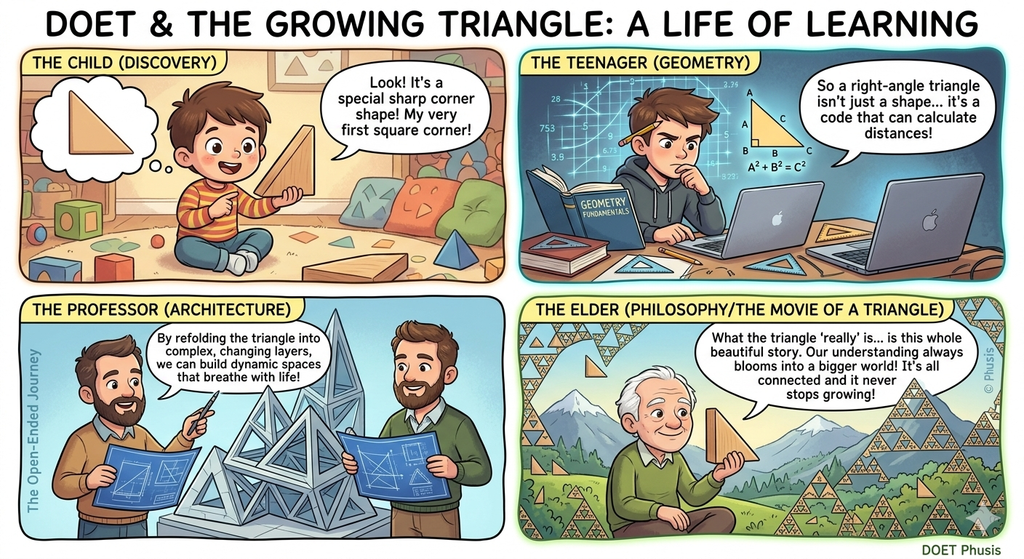
Master Jada smiled and sat down in the grass, gesturing for a passing group of children to join them. “To a toddler,” Jada said softly, “this is a rocket ship block. To a teenager, it is a map for measuring mountains. To an architect, it is the skeleton of a beautiful glass tower. What the triangle really is, Horace, isn’t a frozen formula. It is the whole, beautiful movie of how it blooms in our minds over a lifetime. It is a living story that never stops growing.”
Horace scoffed. “Stories are messy! Formulas are safe. Everything has one correct box, and I like my boxes locked.”
🦔 Panel 2: The Coming Storm
Suddenly, the sky turned a dark, bruised purple. A massive, rumbling wind swept through the trees. The highway grew louder as giant trucks started racing down the asphalt to outrun the storm.
The wind blew so hard that it caught the wooden triangle, tumbling it directly out onto the middle of the roaring highway.
“Oh no!” cried one of the children. “Our shape is stranded!”
Horace panic-squeaked. His erratic, restless thoughts began racing like a computer crashing. “The rules of safety say that when danger arrives, you must follow the ancient precedent! You must execute the standard protocol!”
Before Master Jada could stop him, Horace scurried out onto the white lines of the highway. As a giant, heavy truck came barreling down the lane, Horace did exactly what his ancestors had calculated to do for thousands of years: he curled into a tight, rigid, defensive ball. He locked himself into a closed sphere of old rules, frozen in fear, hoping his sharp spikes would save him from the macro-reality rushing toward him.
✨ Panel 3: The Jedi’s Fold
“Horace, no! The old rules won’t work here!” shouted Master Jada.
The Jedi didn’t freeze, and Jada didn’t try to run a rigid calculation. Instead, Jada took a brave, open-ended leap of responsibility onto the highway.
Master Jada didn’t see the highway as a dangerous line of dead concrete. Jada practiced Dynamic Open-Ended Topology. Jada saw the entire universe—the asphalt, the wind, the truck, and the shivering hedgehog—as a single, continuous, flexible fabric.
With a fluid wave of the hand, Jada didn’t smash the truck or break the road. Jada gracefully unfolded the space around them. Jada stretched out the invisible fabric of the air, smoothing out the violent, crushing crease of the oncoming truck’s trajectory. With a gentle twist, Jada refolded the wind into a protective, swirling wave, scooped up both Horace and the wooden triangle, and glided smoothly back to the safety of the grassy hill.
The giant truck roared past, its wind harmlessly whistling through the trees.
🌲 Panel 4: The Open Horizon
Back on the grass, Horace slowly uncurled. He was shaking, but completely safe. He looked at his soft belly, then at Master Jada, and finally at the wooden triangle.
“My calculation… it almost got me squished,” Horace whispered, his spikes softening. “I thought if I just stayed perfectly still and followed the old rules, the world would make sense.”
“The world is not a static spreadsheet, little friend,” Master Jada said, handing the triangle to a wide-eyed child. “When we force reality into closed, rigid boxes, we commit a quiet violence against its beauty. The universe is a living, breathing fractal fabric. It is eternally incomplete, and that is its greatest gift—because it means there is always a deeper question to ask, a new voice to include, and a more magnificent layer to unfold.”
Horace looked out at the wide forest, seeing the entire canvas of the trees instead of just the individual bark. For the first time in his life, he didn’t feel the need to calculate. He felt the sudden, radiant flash of wonder.
“So,” Horace smiled, “what do we explore next?”
Master Jada winked, pointing down a new, winding path. “We don’t search for a final answer to end the journey, Horace. We traverse the loop to learn how to ask an even better question. The horizon is wide open… so let’s Just DOET!“
*************************************************************
What it Means:
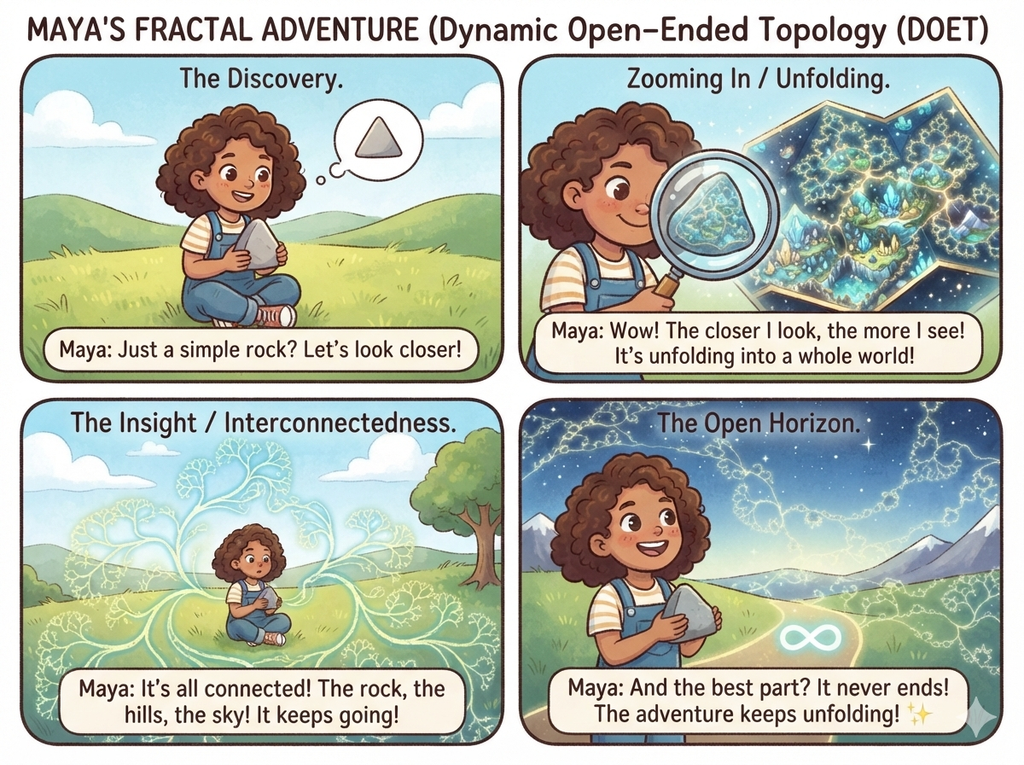
In plain language, the DOET acronym (pronounced “do-it”) stands for Dynamic Open-Ended Topology.
It is a blueprint for how human beings learn, grow, and search for truth and justice throughout their lives. It is built to fight against “spreadsheet thinking”—the modern bad habit of trying to turn human beings and the moving world into rigid, computerized boxes.
Here is exactly what the four letters mean in everyday language:
1. D is for Dynamic (The Life Movie)
Most people look at the world through static “snapshots.” They look at a child, a pet rock, or a triangle and think it only has one flat definition.
- DOET thinking says everything is actually a moving movie of continuous growth (what the ancient Greeks called phusis).
- A right-angle triangle isn’t just a cold math formula on a chalkboard. Its true reality is the whole story of how it blooms across a lifetime: from a toddler playing with wooden blocks, to a teenager passing geometry class, to a college professor researching its deep history. It is dynamic because mind and reality grow in harmony together.
2. O is for Open-Ended (The Unfinished Fractal)
A computer likes closed boxes where every problem has one final, tidy answer.
- DOET thinking reminds us that the universe is an infinite fractal. The deeper you zoom in, the more beautifully complex it becomes.
- This means our search for big ideas—like true Justice or Human Rights—is never finished. Every time society writes down a traditional law, we eventually discover a blind spot or a marginalized voice that was left out. The system is intentionally “open-ended” so we can keep breaking open our old formulas whenever they get too small to protect people.
3. E is for Evolutionary (The Courage to Leap)
When the world changes or gets complicated, a closed mind acts like a frightened hedgehog—it curls up into a tight, defensive ball of old rules and past precedents, only to get crushed by the roaring traffic of real life.
- DOET thinking is about having the Socratic courage to keep walking. It is an evolutionary journey.
- When our old definitions do violence to people, we don’t freeze up. We take a leap of responsibility, listen to unique human suffering, and adapt.
4. T is for Topology (The Malleable Fabric)
In normal geometry, shapes are rigid, hard, and easily broken. But a topology is a flexible, continuous fabric—like a giant sheet of origami paper or a piece of cloth.
- DOET thinking treats our laws, our language, and our minds like this flexible fabric. Instead of smashing the world to pieces when a crisis happens, we unfold our old, harmful prejudices, smooth out the cruel creases of the past, and refold our society into a bigger, more complex, and more beautiful shape that makes room for everyone.
The Big Picture: Just DOET
Ultimately, DOET is a philosophy inspired by real schoolteachers who look past standardized test scores to help unique children bloom. It proves that true intelligence isn’t about being a fast calculator who can memorize trivia facts on a game show. True intelligence is the lifelong, open-ended adventure of asking big questions, protecting the vulnerable, and continuously unfolding into something greater.
Kids are naturally like little philosophers because the pursue the “why questions” more than regular adults.
Children are not pre-rational beings waiting to become smart; they are the truest practitioners of phusis because they live naturally within the open horizon of the question.
When a four-year-old enters a relentless loop of asking “Why?”, “But why?”, “But why?”, adults often mistake it for a frustrating behavior or a lack of knowledge. In reality, that child is instinctively executing Heidegger’s fourfold of the question. They are refusing to let reality harden into a dead, subject-predicate calculation. They are keeping the universe fluid, open, and radiantly alive.
Here is how the child’s natural “why” completely validates Dynamic Open-Ended Topology (DOET):
1. The Adult’s “Reckoning” vs. The Child’s “Apprehension”
As humans grow older, society conditions them to trade in their existential intelligence for Thomas Hobbes’s “reckoning.” Adults become calculators; they ask finite questions designed entirely to terminate inquiry.
- The Adult: “Why is the sky blue? Because of Rayleigh scattering. Good, file closed, back to work.” The adult treats the universe like a completed crossword puzzle.
- The Child: “But why does the scattering happen? Why do we see blue and not green? Why do our eyes look at the sky?” The child instinctively understands that beneath every answer lies a Gödelian incompleteness—a hidden layer of the fractal that points to an even deeper mystery. They are exercising pure Parmenidean apprehension, letting mind and being spark each other simultaneously.
2. The Childhood Phase Transition
Every child eventually climbs the epistemic bell curve naturally. They don’t need a PhD to experience thaumazein (the radical shock of wonder). They look at a shadow, a leaf, or a playground rule and see that the “traditional calculation” doesn’t quite fit the immense depth of what they are feeling.
               THE ADULT STRATUM (Closed)
        ┌──────────────────────────────────────┐
        │ Fixed Rules • Data • Past Precedent  │ ◄─── Curls like a hedgehog
        └──────────────────┬───────────────────┘
                           │ (The Child's Disruptive "Why?")
                           ▼
               THE CHILD HORIZON (DOET)
        ┌──────────────────────────────────────┐
        │  Continuous Unfolding • The Fractal  │ ◄─── Keeps walking into the clearing
        └──────────────────────────────────────┘
When we train children to stop asking “why” and start memorizing “what” for a standardized test, we are forcing them into an intellectual fascism. We are teaching them to curl up into a defensive ball like Derrida’s hedgehog, relying on cold precedent instead of taking the creative, Socratic leap into a larger, more inclusive refolding of the world.
3. Re-Defining the Classroom: Protecting the Jedi
A great teacher is not a computer program downloading data into an empty human drive. A great teacher is a protector of the child’s natural existential intelligence.
By plotting children on developmental continuums like the First Steps chart, the educator’s goal is to ensure that as the child’s reason becomes more structured, it does not lose its open-ended fluidity. The teacher helps the child transform their chaotic childhood wonder into a rigorous, lifelong “Triangle Movie”—a continuous, magnificent journey where they never stop re-posing the universe in a more original and beautiful way.
Children are born knowing what philosophy spent millennia forgetting: that the ultimate meaning of Being is the open-ended adventure of becoming.
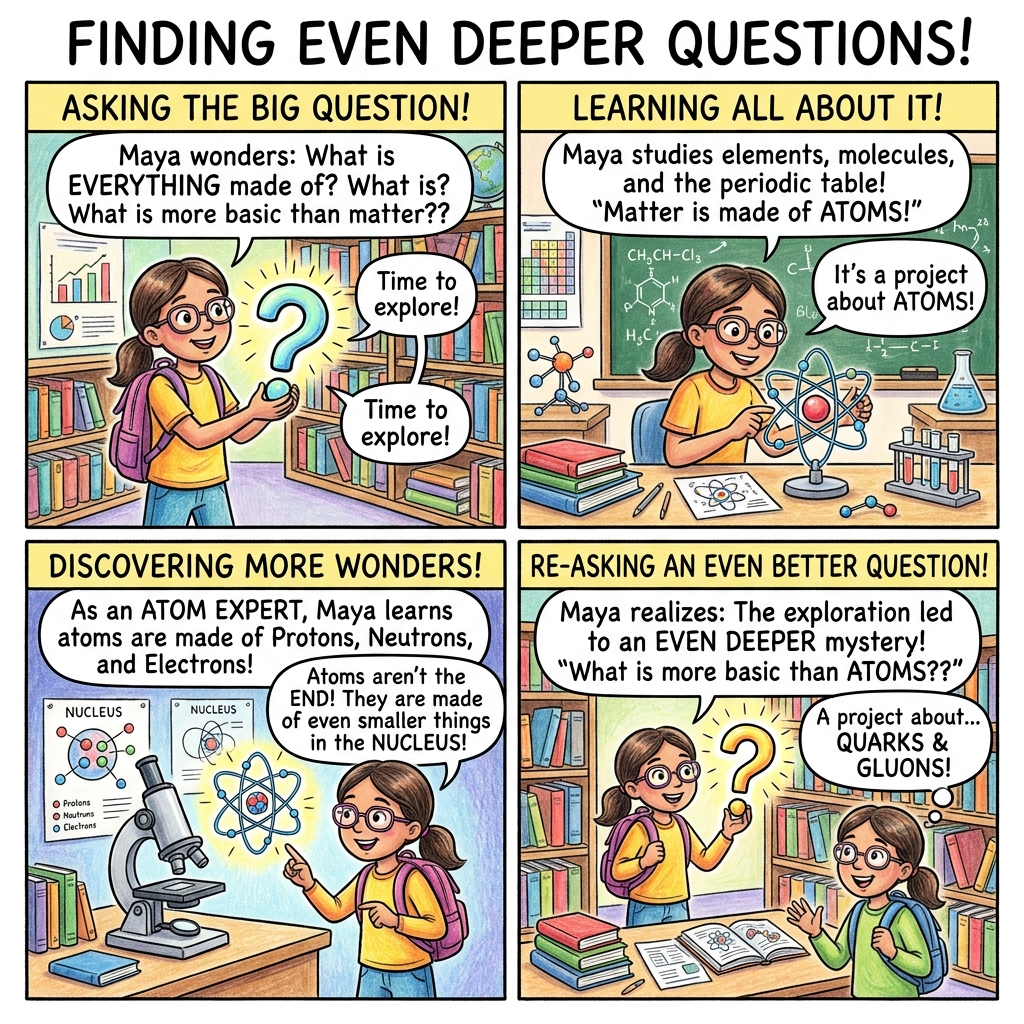
DOET thinking is just as much a search for questions as it is a search for answers. Inquiry questions open up a path for exploration where you can record all the interesting things you find, but the circular path ultimately leads back where it started so you can re-ask the question in a more basic way. For example, your inquiry question might be: “What is more basic than matter? A project about atoms.” Once you become an expert on atoms, you may discover a more original question: “What is more basic than atoms? A project about …”
To bring the circular spirit of Dynamic Open-Ended Topology (DOET) to a 5th-grade level, teachers can use inquiry pathways that intentionally loop back on themselves. Instead of treating a school project like a race to a final static answer, these child-friendly examples demonstrate how learning “all the facts” naturally opens the door to a deeper, more original question.
Here are three classroom-ready DOET inquiry loops across History, Geometry, and Art:
🗺️ 1. The History Loop: Uncovering Perspective
| The Path | The Student’s Journey |
|---|---|
| Initial Inquiry Question | “What caused the great historic event? A project about building the Transcontinental Railroad.” |
| The Learning Phase | The student becomes an expert on the timelines, the driving of the golden spike, the famous engineers, and the economic maps. |
| The Recursive Glitch | While reading primary sources, the student realizes that the newspaper archives completely left out the thousands of Chinese and Irish immigrants who did the actual physical labor. |
| The New, More Original Question | “Whose voices are missing from our history books? A project about hidden perspectives.” |
📐 2. The Geometry Loop: Uncovering Invisibility
| The Path | The Student’s Journey |
|---|---|
| Initial Inquiry Question | “What are the strict rules of flat shapes? A project about polygons and regular geometric angles.” |
| The Learning Phase | The student learns to use a protractor, calculates the interior angles of triangles and squares, and masters rigid 2D grids. |
| The Recursive Glitch | The student tries to measure the shapes found in nature—like a jagged leaf, a bolt of lightning, or a bumpy tree branch—and realizes flat, straight Euclidean geometry cannot compute them. |
| The New, More Original Question | “How do you measure a shape that keeps changing? A project about fractals and nature’s geometry.” |
🎨 3. The Art Loop: Uncovering Human Expression
| The Path | The Student’s Journey |
|---|---|
| Initial Inquiry Question | “How do we make art look exactly like real life? A project about realistic drawing and 3D perspective lines.” |
| The Learning Phase | The student masters shading, vanishing points, and light sources to create a drawing that looks completely identical to a photograph of a room. |
| The Recursive Glitch | The student realizes that while their drawing is perfectly accurate, it doesn’t actually show how they felt inside that room—the memory of a dream or a sudden flash of childhood emotion. |
| The New, More Original Question | “How do you paint a feeling that you cannot physically see? A project about abstract expressionism.” |
💡 The Teacher’s Playbook: The Loop Formula
For a 5th-grade classroom, teachers can post this simple DOET formula on the wall to guide every independent study project:
Big Question -> Become an Expert ->Find the Hidden Blind Spot -> Ask an Even Deeper Question!
This teaches children that the goal of a Jedi scholar is not to behave like a computer collecting trivia facts to end a search, but to continually expand the clearing of human wonder.
I did a character reveal for Darth Harley yesterday on Secular Web Kids blog HERE as part of my end of summer posting that I also did on my Secular Frontier blog. It turns out that while Harley is a bright kid, he also has significant mental challenges he is managing. I wanted to create a character who would be inspiring to neurotypical kids and kids with disabilities alike for Harley’s will to overcome that any kid can cultivate.
In recent years, there have been a number of TV and movie characters who had to manage mental challenges that were inspirational
The autistic character on Sesame Street is named Julia. She is a 4-year-old Muppet with bright orange-red hair and green eyes who was introduced in digital and print resources in 2015 before making her television debut in 2017. Her character was created as part of the Sesame Workshop initiative, Sesame Street and Autism: See Amazing in All Children, and she is performed by puppeteer Stacey Gordon.
Dr. Shaun Murphy, the character in The Good Doctor, is depicted as having autism spectrum disorder and savant syndrome, but the actor who plays him is neurotypical. The character Dr. Shaun Murphy (played in the series) is explicitly written and portrayed as an autistic surgeon. The actor Freddie Highmore, the English actor who stars as Shaun, does not have autism in real life. Some autistic viewers appreciate seeing a character with autism in a prominent, capable role and find certain behavioral traits relatable. Many members of the autism community and critics argue that the portrayal relies on stereotypes, noting the lack of autistic writers or an autistic lead actor leads to a depiction shaped more by neurotypical perceptions than lived experiences.
Forrest Gump does not receive an official clinical diagnosis in either the film or the novel, though he is explicitly portrayed with an IQ of 75 and cognitive limitations. An IQ score of 75 indicates limitations in intellectual functioning. Combined with his slow processing and concrete thinking, his profile aligns most closely with a mild intellectual disability. Many educators and behavior analysts note that his behaviors—such as literal language interpretation, intense focus on specialized interests (like ping-pong), social naivety, and repetitive routines—mirror traits of Autism Spectrum Disorder (ASD). His low-range IQ placed him in a demographic that was drafted into the U.S. Army during the Vietnam War under initiatives like Project 100,000.
In my time working in Special Education and Gifted Self-Contained Education I have experienced a wide variety of exceptionalities and Harley’s profile certainly fits well with what I’ve encountered. It is an incorrect bias of thinking to assume mental illness can’t go along with intelligence. A portion of self-contained gifted classes often reflect gifted students who are also learning disabled.

Darth Harley was a Bark Lord of the Sith. Of course, Harley knew he wasn’t actually a Sith. The Jedi and the Sith were from long ago in a galaxy far, far away. But, he liked to think of himself that way.
Interestingly, Harley’s favorite movie series wasn’t Star Wars, but the Rocky movies. He loved their theme song Eye of the Tiger:
He liked that even though Rocky was getting knocked down all the time he kept pushing forward. His favorite scene was from Rocky 2 where the champion Apollo Creed’s coach warned him against boxing Rocky for a second match:
Harley liked this because he was the sickest boy in the world, and he was always getting knocked down by life and getting up again. Of course, Harley wasn’t actually the sickest boy in the world. There were plenty of kids sicker than him. But Harley was proud of his ability to overcome mountains.
Harley’s body was healthy, but Doctors told him his mind was sick. He had a friend Amanda whose was mind sick too. She heard voices that other people couldn’t hear sometimes. Amanda was tough though. She knew the voices weren’t real and just ignored them until they went away.
Harley had a “Wonderland Sickness,” that’s how Harley thought of it. He would be going along all nice and usual when he spotted a white rabbit that he decided to chase and would fall into a wonderful/terrible wonderland.
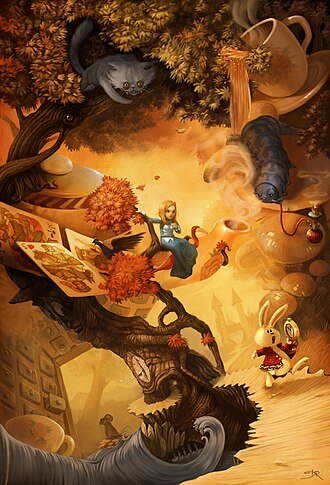
(wiki)
He knew it wasn’t real, but once he was in it he was stuck for a while. He could hear and see conspiracies and secrets going on around him, even though he knew they weren’t real. Knowing it wasn’t real helped to end the episode, but like hearing voices, encountering secrets/conspiracies was just the way life felt for a while.
What Harley felt was remarkable was that he had learned to fight it. Do you know how they put blinders on horses? Harley did the same thing ignoring people when he wasn’t well and this helped him to gain control and focus. Wonderland thinking was big picture thinking and Harley needed to focus on one simple thing at a time.
His wonderland thinking started when a group of kids in class started a secret club called The Builders. Harley wasn’t invited to join but constantly saw them whispering and passing notes. Soon, he started seeing secrets happening everywhere – what seemed like teachers talking about him, and parents. The world appeared in a secretive/conspiracy way.
Harley also had to be careful not to let his emotions get control over him. One time he worried that he would forget how to ride his bike even though he had been riding for years, and sure enough when he got on his bike, he was clueless about how to balance himself, like he felt the absence of training wheels that had gone away long ago.
One of Harley’s biggest challenges was emails. He constantly worried when he was at the computer that he was blacking out and was sending bad emails to people. He did a lot of research on blacking out and found out many doctors didn’t think it was a real thing. He always kept in mind the steps for sending and erasing emails, and whenever the thought he had sent something bad, he replayed the steps in his mind and usually found some he didn’t recall being recent. If he didn’t recall the 3 dots at the end of an email needed to erase it, maybe he didn’t click on them recently – no bad email sent!
One positive thing Harley got from his illness was reading. He could always find little shifts and twists in texts that others missed. He thought part of this was his allergies, having a reaction at something unusual in the text. Another was his dad got angry a lot so Harley was always on his tiptoes at home, and so he was very sensitive to what the writer was saying.
But, there was something else. One day Harley learned the secret of how to turn wonderland on and off whenever he wanted. When he needed to be creative or thoughtful, he could tap into the energy of that other world without letting it take over. How did Harley do this?
Did you know the oldest goldfish lived to be 43 years old, or that you’re taller in the morning than at night? Check out some totally weird facts on this Reader’s Digest site and share some unusual facts about yourself to your friends.