
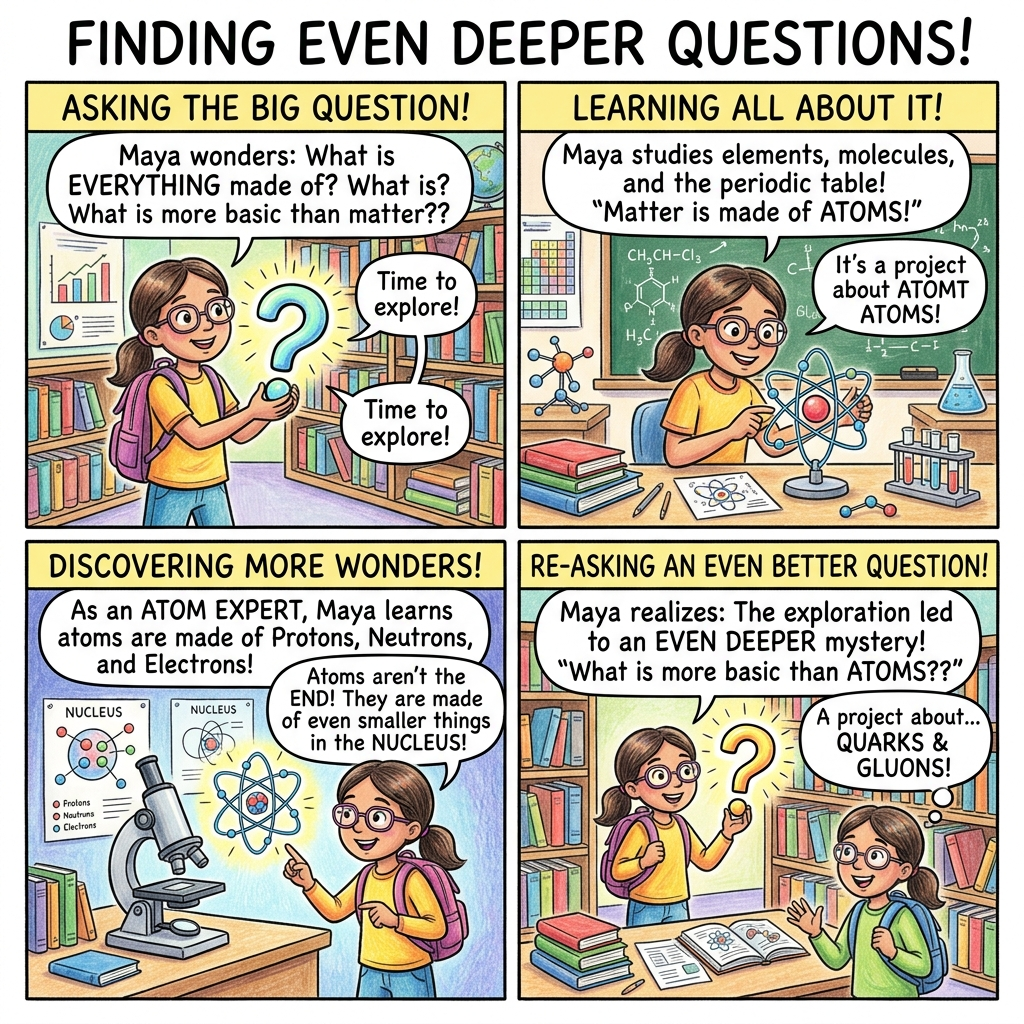
DOET thinking is just as much a search for questions as it is a search for answers. Inquiry questions open up a path for exploration where you can record all the interesting things you find, but the circular path ultimately leads back where it started so you can re-ask the question in a more basic way. For example, your inquiry question might be: “What is more basic than matter? A project about atoms.” Once you become an expert on atoms, you may discover a more original question: “What is more basic than atoms? A project about …”
To bring the circular spirit of Dynamic Open-Ended Topology (DOET) to a 5th-grade level, teachers can use inquiry pathways that intentionally loop back on themselves. Instead of treating a school project like a race to a final static answer, these child-friendly examples demonstrate how learning “all the facts” naturally opens the door to a deeper, more original question.
Here are three classroom-ready DOET inquiry loops across History, Geometry, and Art:
🗺️ 1. The History Loop: Uncovering Perspective
| The Path | The Student’s Journey |
|---|---|
| Initial Inquiry Question | “What caused the great historic event? A project about building the Transcontinental Railroad.” |
| The Learning Phase | The student becomes an expert on the timelines, the driving of the golden spike, the famous engineers, and the economic maps. |
| The Recursive Glitch | While reading primary sources, the student realizes that the newspaper archives completely left out the thousands of Chinese and Irish immigrants who did the actual physical labor. |
| The New, More Original Question | “Whose voices are missing from our history books? A project about hidden perspectives.” |
📐 2. The Geometry Loop: Uncovering Invisibility
| The Path | The Student’s Journey |
|---|---|
| Initial Inquiry Question | “What are the strict rules of flat shapes? A project about polygons and regular geometric angles.” |
| The Learning Phase | The student learns to use a protractor, calculates the interior angles of triangles and squares, and masters rigid 2D grids. |
| The Recursive Glitch | The student tries to measure the shapes found in nature—like a jagged leaf, a bolt of lightning, or a bumpy tree branch—and realizes flat, straight Euclidean geometry cannot compute them. |
| The New, More Original Question | “How do you measure a shape that keeps changing? A project about fractals and nature’s geometry.” |
🎨 3. The Art Loop: Uncovering Human Expression
| The Path | The Student’s Journey |
|---|---|
| Initial Inquiry Question | “How do we make art look exactly like real life? A project about realistic drawing and 3D perspective lines.” |
| The Learning Phase | The student masters shading, vanishing points, and light sources to create a drawing that looks completely identical to a photograph of a room. |
| The Recursive Glitch | The student realizes that while their drawing is perfectly accurate, it doesn’t actually show how they felt inside that room—the memory of a dream or a sudden flash of childhood emotion. |
| The New, More Original Question | “How do you paint a feeling that you cannot physically see? A project about abstract expressionism.” |
💡 The Teacher’s Playbook: The Loop Formula
For a 5th-grade classroom, teachers can post this simple DOET formula on the wall to guide every independent study project:
Big Question -> Become an Expert ->Find the Hidden Blind Spot -> Ask an Even Deeper Question!
This teaches children that the goal of a Jedi scholar is not to behave like a computer collecting trivia facts to end a search, but to continually expand the clearing of human wonder.